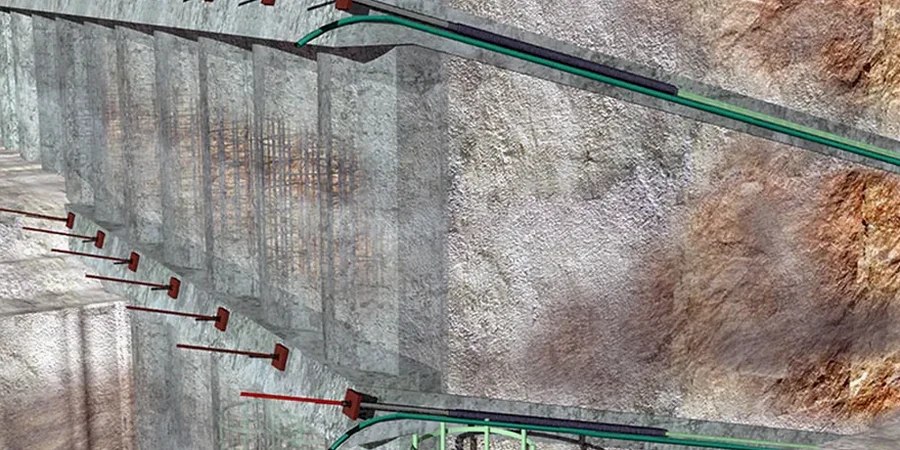
A five-story parking structure near the Cheyenne Depot Plaza needed 40-foot tiebacks into the Pierre Shale formation. The contractor drove two test anchors before realizing the bond length was too short for the weathered claystone contact zone. That job taught us something about Cheyenne: the transition between terrace gravels and underlying bedrock is rarely a clean contact. Our laboratory runs direct pullout verification on grout-to-ground bond specimens, preparing anchor designs that account for the stiff, overconsolidated clays common across Laramie County. We combine anchor design with slope stability analysis when the excavation face intersects colluvial slopes along Crow Creek, and with retaining wall design for permanent shoring systems where right-of-way limits restrict tieback inclination.
An anchor is only as reliable as its bond zone grout. In Cheyenne's expansive claystone, we verify that bond stress assumptions survive freeze-thaw reality.
Our approach and scope
Cheyenne sits at 6,062 feet elevation with freeze-thaw cycles that penetrate three to four feet into the ground from October through April. This seasonal action directly affects anchor head corrosion and grout column integrity. We specify double-corrosion protection for permanent anchors within the frost zone, referencing PTI DC35.1 guidelines for Class I protection. For temporary excavation support, single-corrosion protection is adequate when the anchor service life is under 24 months. Our technicians run pullout tests on sacrificial anchors at each site to validate ultimate bond stress values before production drilling begins. The expansive claystone common in Cheyenne's bedrock requires particular attention to bond zone length. We often extend bond lengths by 20 percent beyond calculated values when the weathered zone exceeds five feet in thickness. Anchor capacity verification follows ASTM D4435 procedures with load-hold cycles at 25, 50, 75, 100, and 133 percent of design load. The high diurnal temperature swings in southeastern Wyoming accelerate grout curing in summer, so we adjust water-cement ratios seasonally to maintain pumpability without sacrificing compressive strength.
Regulatory framework
ASTM D4435 – Standard Test Method for Rock Bolt Anchor Pull Test, PTI DC35.1 – Recommendations for Prestressed Rock and Soil Anchors, FHWA GEC No. 4 – Ground Anchors and Anchored Systems, AASHTO LRFD Bridge Design Specifications, Section 11 – Abutments and Retaining Walls, ACI 318 – Anchoring to Concrete provisions for structural connections
Quick answers
What is the difference between active and passive anchors?
Active anchors are prestressed after installation: we apply a lock-off load (typically 70-100% of design load) to the tendon before locking the anchor head against the bearing plate. This preloads the ground and limits movement before excavation proceeds. Passive anchors, including soil nails, are not prestressed. They develop resistance only when the ground deforms enough to load the tendon. For Cheyenne projects, we specify active anchors when allowable wall deflections are under 0.5 inches, and passive nails when some deformation is acceptable and the excavation is temporary.
How much does anchor design and testing cost in Cheyenne?
Anchor design and testing services in Cheyenne typically range from US$1,170 to US$3,520 depending on the number of anchors, the testing protocol required, and whether sacrificial test anchors are included. A basic design package with two proof tests for a small excavation might fall at the lower end, while a full design submittal with multiple performance tests and corrosion protection specifications for a permanent tied-back wall will be at the upper end of the range.
How do you determine the bond length for anchors in Cheyenne's shale?
We start with empirical bond stress values for stiff clay shale from FHWA GEC No. 4, then adjust based on site-specific pullout tests. The weathered zone thickness is critical: we log each anchor hole during drilling and measure the depth to competent gray shale. If the weathered zone exceeds five feet, we extend the bond length by 20 percent and may specify pressure grouting to improve bond in fractured material. Sacrificial test anchors are loaded to failure to confirm ultimate bond stress before production anchor lengths are finalized.
What corrosion protection does a permanent anchor need?
Permanent anchors in Cheyenne require Class I double-corrosion protection per PTI DC35.1. This means a corrugated plastic sheath over the entire tendon with grout filling the annular space between the sheath and the bar or strand, plus an outer encapsulating sheath over the bond length. The anchor head assembly must be fully grouted into a recessed pocket after lock-off. We also specify a minimum 2-inch grout cover between the outer sheath and the borehole wall. For temporary anchors with less than 24-month service life, single-corrosion protection with a minimum 1-inch grout cover is generally sufficient.