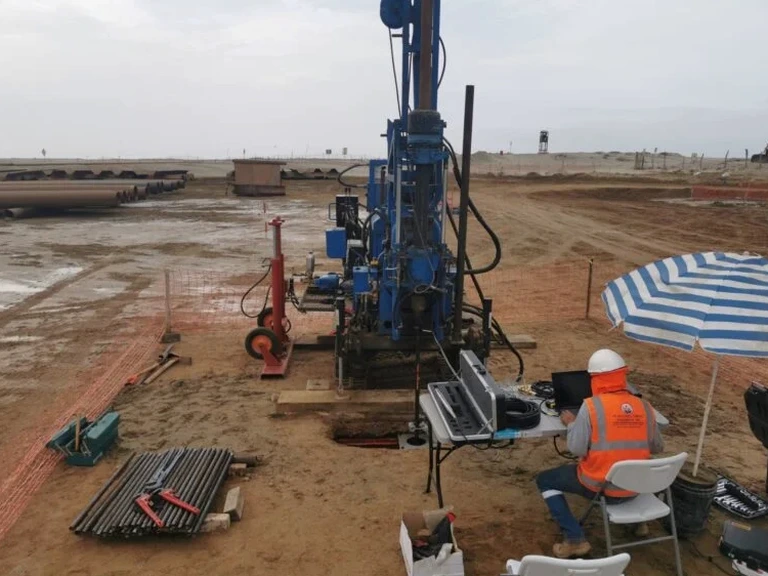
The soils west of Warren Avenue and the terrain near South Greeley Highway behave nothing alike. West Cheyenne sits on weathered granite and shallow bedrock, while the southeast draws basin fill, silts, and occasional organic lenses that go soft under load. A standard SPT rig can misread those transitions — and it takes a CPT test with continuous cone resistance and pore pressure measurement to separate compaction from shear strength, layer by layer. Our field crew runs a 20-ton CPT truck with a 15 cm² electric cone, pushing to refusal or 25 meters in sandy clay profiles common across Laramie County. The data stream feeds direct into corrected tip resistance (qt), sleeve friction (fs), and friction ratio (Rf), which we correlate against Robertson (1990) and soil behavior type charts calibrated for high-plains alluvium. For engineers designing on the Pierre Shale contact or where groundwater rises within 2 meters of grade, that resolution matters.
A single CPT sounding replaces six SPT borings in stratigraphic resolution — and returns data every 2 centimeters.
Our approach and scope
A mistake we see across Cheyenne is using blow-count correlations on silty sands without pore pressure dissipation checks. The IBC and ASCE 7 classify Site Class D and E based on shear-wave velocity or undrained shear strength — but when a contractor eyeballs a split-spoon sample and calls it medium dense, they miss thin soft seams that control settlement. CPT profiling erases that guesswork. The cone tip records resistance every 2 centimeters. Sleeve friction captures grain-size shifts. Pore pressure dissipation tests tell you how fast the formation drains. Combined, those three channels flag liquefiable layers, identify the preconsolidation pressure in overconsolidated clay, and assign a soil behavior type without a single bag sample. In fill areas near the Union Pacific yards, we've run CPT soundings that revealed 3 meters of uncontrolled fill over natural alluvium — a profile invisible to conventional borings. The data exports as Excel and gINT files ready for LPile, Settle3D, or Plaxis input. Any geotechnical report that skips this level of resolution starts with a handicap.
Local ground factors
Laramie County sits on a seismic acceleration of 0.15g at the 2% in 50-year hazard level, and the water table in the South Crow Creek drainage hovers within 2.5 meters of surface during spring melt. Combine those two facts, and you have a liquefaction risk that SPT-based screening can underestimate by 20 percent in silty profiles. Cone penetration data gives you a direct cyclic resistance ratio (CRR) from normalized tip resistance and fines content inferred from friction ratio — no correction factors borrowed from California sites. The Youd-Idriss (2001) framework, paired with CPT-based CRR charts by Boulanger & Idriss (2014), is our standard output for any project east of Interstate 25 where Holocene alluvium dominates. Settlement in soft clay is the other silent expense. Dissipation data from a CPT run provides the coefficient of consolidation (cv) needed for time-rate settlement analysis, cutting the guesswork that pad-footing designs often carry.
Quick answers
How deep can a CPT truck push in Cheyenne soils?
In the alluvial silts and sands south of the Union Pacific corridor, our 20-ton rig routinely reaches 20 to 25 meters before hitting refusal. Where the Pierre Shale is shallow — common west of Yellowstone Road — refusal occurs between 8 and 14 meters. We always pre-drill through pavement or hardpan when needed.
What does a CPT report include for a foundation design in Laramie County?
A sealed report contains corrected tip resistance (qt), sleeve friction (fs), friction ratio (Rf), pore pressure (u₂), soil behavior type (SBTn) per Robertson charts, undrained shear strength (Su), constrained modulus (M), and bearing capacity estimates for shallow footings. We also include dissipation data and liquefaction screening if groundwater was detected.
Can CPT replace test pits and SPT drilling on a Cheyenne commercial site?
CPT delivers continuous stratigraphy and geotechnical parameters without sampling, so it often reduces the number of conventional borings required. However, the City of Cheyenne building department still requires physical samples for Atterberg limits and consolidation testing on certain projects. We typically combine one SPT boring for index samples with a grid of CPT soundings.
What is the typical cost of a CPT sounding in the Cheyenne area?
A single CPT sounding in Laramie County runs between US$180 and US$240 per meter, depending on access, depth, and whether pore pressure dissipation tests are needed. Mobilization is quoted separately based on distance from our staging yard.