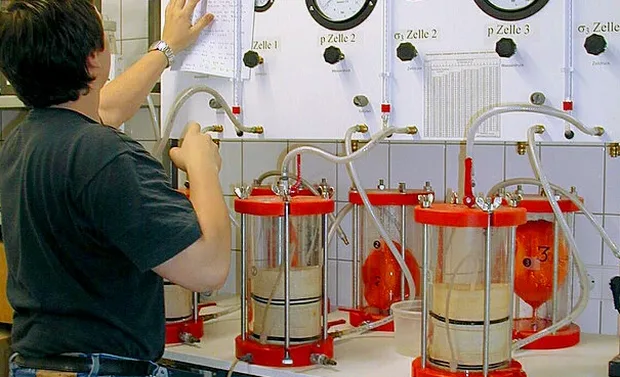
A standard CBR loading frame sits in our lab, equipped with a calibrated 50 kN load cell and a displacement transducer tracking penetration at 1.27 mm per minute. The steel plunger presses into a 152 mm diameter compacted specimen while we record the force needed to reach 2.5 and 5.0 mm penetration. For Cheyenne projects, we prepare samples at moisture contents that reflect the local semi-arid climate, where average annual precipitation hovers around 16 inches and native silty-clay subgrades can lose strength rapidly when wet. Before the CBR test, we often run a Proctor compaction curve on the same borrow material to establish the optimum moisture and maximum dry density, then compact specimens at those target values. In parallel, a grain size analysis confirms whether fines content exceeds 35 percent, which is common in the Pierre Shale-derived soils found across Laramie County.
A soaked CBR below 3% in Cheyenne's claystone subgrades demands either removal and replacement or chemical stabilization before placing base course.
Local ground factors
A common mistake we see on Cheyenne job sites is assuming that a visually dry, hard clay subgrade will hold up under traffic without a proper soaked CBR evaluation. Contractors sometimes approve the pavement section based on a single unsoaked test, only to watch the road rut and crack after the first wet spring when the subgrade softens to a fraction of its dry strength. The difference between an unsoaked CBR of 12 and a soaked CBR of 2 is not unusual in the silty clays east of town near the Crow Creek drainage. If the design CBR is overestimated by even a few points, the resulting asphalt or concrete thickness will be undersized, leading to premature fatigue cracking and expensive mill-and-overlay repairs within three to five years. We have also encountered cases where imported granular fill was accepted without CBR verification, and the material degraded under moisture, dropping the effective support below AASHTO 93 design assumptions. A laboratory CBR test costs a fraction of one failed pavement section, and the turnaround time is short enough that there is no schedule excuse to skip it.
Quick answers
What does a laboratory CBR test cost in Cheyenne?
For a standard soaked CBR test on a single sample, our fee in Cheyenne ranges from US$130 to US$200, depending on whether swell monitoring and Proctor data are included. If you need multiple points to build a CBR-versus-density curve, the total cost scales with the number of specimens. We provide a fixed-price quote before starting any work.
How long does it take to get CBR results in Cheyenne?
The soaking period required by ASTM D1883 is 96 hours, so the absolute minimum turnaround is four days after specimen preparation. With compaction, soaking, and reporting, most Cheyenne projects receive final results within five working days. We can expedite unsoaked CBR testing in 24 hours if the project schedule demands it.
Which CBR value should we use for pavement design, soaked or unsoaked?
We always recommend using the soaked CBR value for design in Cheyenne. The local claystone subgrades can lose more than half their strength when saturated during spring snowmelt, and designing with the unsoaked value leads to underbuilt pavement sections that rut within a few seasons. WYDOT and AASHTO design procedures both specify soaked CBR as the basis for structural number calculations.