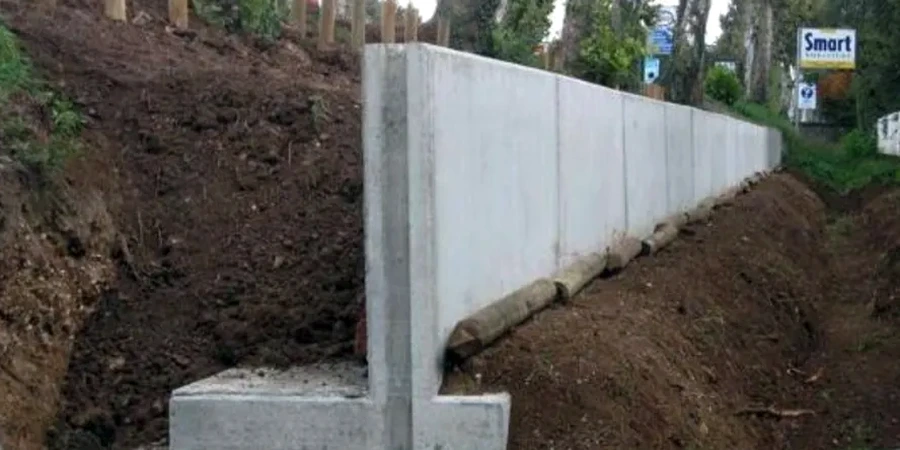
The most common retaining wall failure in Cheyenne isn't dramatic collapse—it's the slow, inexorable lean that shows up two winters later. Contractors who treat the local soil like standard fill learn this the hard way. Southeastern Wyoming's geology is unforgiving: the Pierre Shale and expansive claystone beneath the city's thin topsoil can swell 10% or more with seasonal moisture changes. When that swelling meets a rigid wall without proper drainage and a reinforced backfill zone, something has to give. Our approach starts with characterizing that specific ground. A site investigation might combine test pits to observe the weathered shale interface directly with Atterberg limits testing to quantify the clay's plasticity risk before a single wall dimension is drafted.
In Cheyenne's expansive clays, a retaining wall without a capillary break and a solid drainage core is just a temporary barricade against lateral earth pressure.
Our approach and scope
ASCE 7-22 and the IBC set the structural baseline, but the real design parameters in Cheyenne come from the subsurface. The weathered granite of the Laramie Range, visible on the city's western horizon, provides excellent bearing material for footings when encountered, but its depth varies dramatically—from surface outcrops near the airport to over forty feet of claystone overburden closer to Crow Creek. A retaining wall founded partially on rock and partially on stiff clay is asking for differential settlement, which is why we integrate
CPT testing to map the refusal depth continuously across the wall alignment. The design must also handle the city's specific frost depth requirements, typically 36 inches minimum, to prevent frost heave from undermining the footing. Where conventional drainage is constrained by site boundaries, we often specify lightweight aggregate backfill or geocomposite drainage layers to reduce the driving forces without widening the excavation. For walls exceeding six feet in height, global stability becomes the controlling factor, and the design must consider the
slope stability of the retained mass, especially if the wall supports a roadway or existing structure.
Quick answers
How much does a retaining wall design cost for a residential project in Cheyenne?
For a typical residential retaining wall project in Cheyenne, the geotechnical investigation and structural design typically range from US$940 to US$4,680, depending on wall height, linear footage, and the complexity of the subsurface conditions. A taller wall requiring a drilled shaft foundation or a global stability analysis will be at the upper end of this bracket.
What makes Cheyenne's soils so problematic for retaining walls?
The Pierre Shale and weathered claystone that underlie much of Cheyenne are highly expansive, meaning they swell significantly when wet and shrink when dry. This volume change can impose large lateral pressures on a wall, especially if the backfill is not designed as a free-draining, non-expansive zone. The winter freeze-thaw cycle also creates ice lenses that increase pressure if drainage is inadequate.
Do I need a permit and an engineer's stamp for a retaining wall in Cheyenne?
Per the IBC as adopted by the City of Cheyenne, any retaining wall over four feet in height measured from the bottom of the footing to the top of the wall requires a building permit and a design sealed by a Wyoming-licensed professional engineer. Walls supporting a surcharge, such as a driveway or building, must be engineered regardless of height.
Can you design a retaining wall that also functions as a basement wall?
Yes, a basement wall is essentially a special case of a retaining wall with a top restraint. The design must handle at-rest earth pressures, which are higher than active pressures, and include waterproofing details that work with Cheyenne's frost depth. We design these as permanent cantilever or propped walls, integrating the lateral support from floor diaphragms.