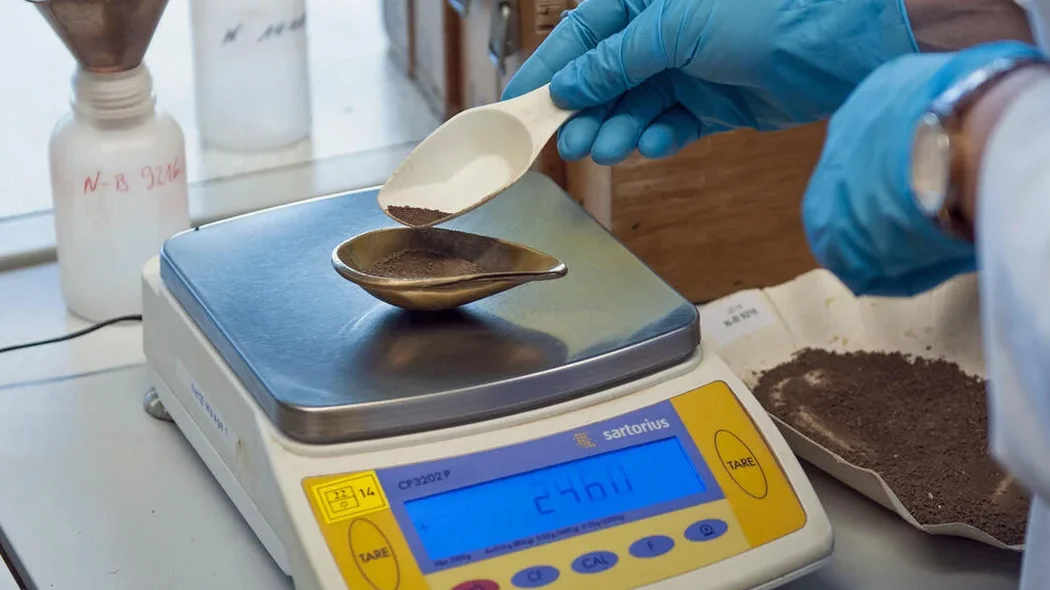
In Cheyenne, we often see imported fill that looks fine in the borrow pit but turns into a grading nightmare once it hits the high plains wind. The fines content shifts, moisture packs in, and suddenly the spec'd compaction is impossible to hit. That's where a proper grain size distribution curve saves the project — not just for classification, but for predicting how the material will behave during Cheyenne's freeze-thaw cycles. The combination of mechanical sieving and hydrometer analysis following ASTM D6913 lets us nail down the exact sand-silt-clay fractions, which matters a ton when you're dealing with the residual soils derived from weathered Pierre Shale and the alluvial deposits along Crow Creek. For deeper bearing layers, we often pair the gradation data with results from SPT drilling to correlate fines content with blow counts, giving you a fuller picture of the stratigraphy before foundation design begins.
Coefficient of uniformity below 3 in a Cheyenne subgrade almost guarantees poor compaction and future settlement — the gradation curve tells you before the roller does.
Our approach and scope
Drive from the North College Drive commercial strip down to the residential pockets near Holliday Park, and you'll cross at least three different depositional environments without realizing it. The granular base on the north side tends to be coarser, with D60 values often exceeding 2 millimeters, while the soils closer to the creek carry a higher percentage of fines passing the #200 sieve — sometimes north of 35 percent. This variability means a one-size-fits-all spec for structural fill doesn't work. Our lab runs the full stack: #4, #10, #40, #100, and #200 sieves plus hydrometer readings at 15, 30, 60, and 1440 minutes to build the complete curve from gravel down to the 2-micron clay fraction. When the gradation shows gap-graded or uniformly graded material near proposed footings, we typically recommend checking the compaction response with a
Proctor test to dial in the moisture-density relationship before placing any fill. The high elevation here — roughly 6,100 feet — also affects hydrometer settling times slightly, and our technicians adjust the Stoke's law calculations for the local fluid density and temperature conditions.
Local ground factors
The hydrometer cylinder sits in a constant-temperature bath on the bench, and for 24 hours we watch the density drop as silt and clay settle out at different rates. It's a deceptively simple procedure that carries a lot of risk if the sample prep is sloppy. In Cheyenne's semiarid climate, soils often contain gypsum crystals and soluble salts that flocculate the fines — if you don't pre-wash the sample and remove the carbonates with a pH-adjusted rinse, the hydrometer will show an artificially low clay fraction because the particles clump together instead of settling individually. That error cascades into a wrong USCS classification: a fat clay (CH) gets misread as a silt (ML), and suddenly the expansive potential is missed entirely. Given that Laramie County has mapped units of the Pierre Shale with liquid limits exceeding 60, misclassifying a CH as an ML is an expensive mistake. We run parallel Atterberg limits on the minus #40 fraction whenever the hydrometer curve suggests more than 15 percent clay, to cross-check the plasticity against the gradation and confirm the classification before it goes into the geotechnical report.
Quick answers
What's the difference between the sieve analysis and the hydrometer test?
The sieve analysis handles particles larger than 0.075 mm (retained on the #200 sieve) by mechanically shaking a stack of sieves and measuring the mass retained on each. The hydrometer test measures the sedimentation rate of particles smaller than 0.075 mm — silts and clays — suspended in a water column, using Stoke's law to back-calculate particle diameter from settling time. Together they give the complete grain size distribution curve from gravel down to the 2-micron clay fraction.
How much sample material do you need for a complete grain size analysis?
For a combined sieve and hydrometer test per ASTM D6913, we need approximately 500 grams of dry soil passing the #4 sieve. If the material is predominantly gravel, we may request up to 5 kilograms to ensure a representative split. The sample should be sealed in a moisture-tight bag immediately after collection to prevent drying that could alter the natural aggregation of fines.
What does a grain size analysis typically cost in the Cheyenne area?
A complete sieve plus hydrometer analysis generally runs between US$100 and US$200, depending on whether it's a single sample or part of a larger geotechnical testing package. Expedited turnaround may add a surcharge. We recommend bundling grain size with Atterberg limits for a more complete soil classification at a better per-test rate.
How long does it take to get results back from the lab?
Standard turnaround for a full sieve and hydrometer analysis is 3 to 5 business days. The hydrometer portion alone requires a minimum of 24 hours of sedimentation readings, plus oven-drying and data reduction time. We offer a 48-hour expedited option for single-point verification on active construction sites, with the understanding that the hydrometer readings may be truncated at 6 hours for preliminary classification.