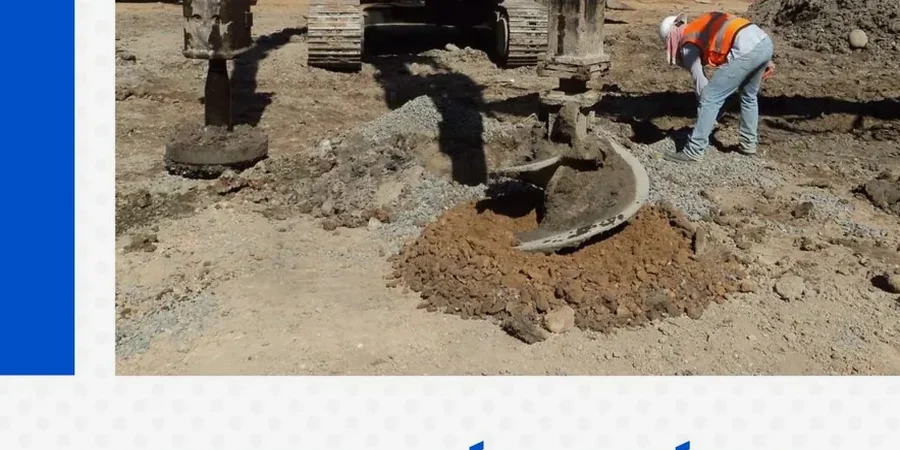
The high plains around Cheyenne don't give you much warning. One season the ground is dry and cracked, the next it heaves after a few snowmelt cycles. That's the reality of designing foundations on the Pierre Shale and loess deposits that blanket much of Laramie County. In our experience, conventional shallow footings here become a gamble when the claystone swells with moisture or the loess collapses under load. Stone column design offers a way around that—by replacing a portion of the weak soil with compacted granular columns, you create a composite ground mass that drains, densifies, and transfers load to more competent strata. We've seen this approach work on warehouse slabs out by the Cheyenne Logistics Hub and on water tanks near Crow Creek, where the atterberg limits of local clay consistently show plasticity indices above 25. The key is pairing the vibro-replacement technique with a solid understanding of Cheyenne's semi-arid moisture cycles, because what drains well in August might still heave in March if the gravel column isn't sized for the full wetting depth.
A well-designed stone column in Cheyenne's expansive clay doesn't just reduce settlement—it creates a drainage path that breaks the heave cycle altogether.
Local ground factors
The soil profile east of I-25, around the South Greeley Highway corridor, tends to be sandier with intermittent gravel lenses—decent drainage, lower swell potential. But head west toward the historic Avenues district, and you're into fat clay over shale that hasn't seen a dry season in a century where it didn't crack foundations. The risk isn't uniform across Cheyenne, and that's what trips up designers who apply a single ground improvement recipe. Stone columns in the eastern zone might need closer spacing to handle loose alluvium that can settle under vibration, while columns in the western zone need deeper penetration to bypass the active swelling zone entirely. Another risk we track carefully is the groundwater fluctuation: the Ogallala aquifer isn't present under Cheyenne proper, but perched water tables appear seasonally in low-lying areas near Dry Creek. If columns terminate in a zone that becomes saturated, the effective stress changes and long-term settlement can creep upward beyond what the design predicted. We always recommend a pre-construction in-situ permeability test in those areas to confirm drainage assumptions before mobilizing the vibroflot.
Regulatory framework
ASTM D2487 – Standard Practice for Classification of Soils for Engineering Purposes, FHWA-NHI-16-027 – Ground Improvement Methods, Vol. I, ASTM D698 – Standard Test Methods for Laboratory Compaction Characteristics of Soil (Proctor), ASCE 7-22 – Minimum Design Loads for Buildings and Other Structures, IBC 2021 – International Building Code, Chapter 18
Quick answers
How much does stone column design and testing cost in Cheyenne?
For a typical commercial project in Cheyenne, the combined cost of geotechnical investigation, stone column design, and load test verification runs between US$1,440 and US$5,130, depending on the number of borings, column depth, and whether a single or group load test is required. Smaller residential or light commercial projects fall on the lower end, while industrial sites with deeper columns and multiple test locations approach the upper range.
Do stone columns work in Cheyenne's expansive Pierre Shale?
Yes, but the columns need to extend through the entire active zone of moisture fluctuation. In Cheyenne, that usually means penetrating 10 to 15 feet into weathered shale. The gravel column provides a vertical drainage path that equalizes moisture and reduces differential heave. We also specify a geotextile encasement near the top of the column in highly plastic zones to prevent clay intrusion into the stone matrix over time.
What aggregate is used for stone columns in Wyoming?
We specify clean, hard, angular stone meeting ASTM D448 No. 57 or No. 67 gradation—typically crushed granite or limestone sourced from regional quarries near Laramie or Greeley. The material must have less than 5% passing the No. 200 sieve to maintain permeability, and we verify this with a wash sieve before the contractor begins installation.
How long does stone column installation take in Cheyenne?
A crew of three to four with a vibroflot can install 20 to 30 columns per day in Cheyenne's typical soil profile. A full commercial site with 200 columns usually completes in two to three weeks, not including mobilization, pre-drilling, and load testing. Weather can slow things down between November and March when snow cover and frozen ground require site preparation.
What testing is required after stone columns are installed?
We follow a verification program that includes modulus load tests on at least one column per 5,000 square feet of treated area, plus SPT or CPT soundings between columns to confirm the density improvement. For critical structures, we also run cross-hole seismic tests to measure the shear wave velocity increase in the treated soil mass.