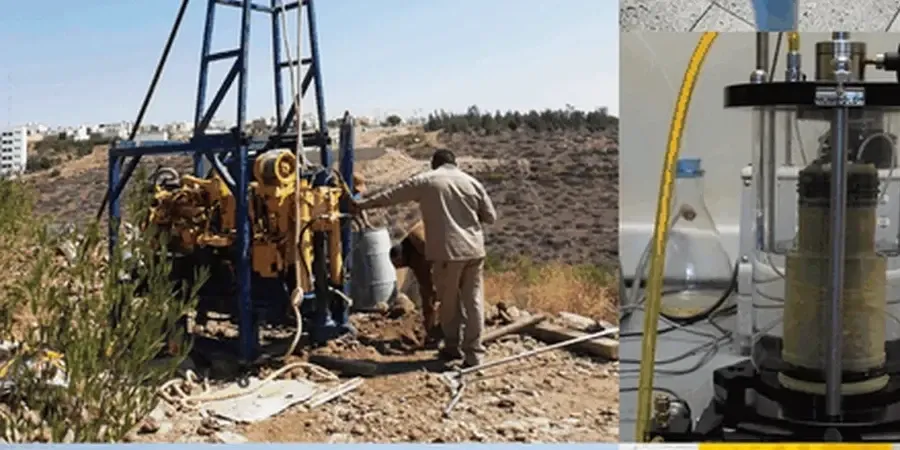
The most expensive mistake we see in Cheyenne is structural overdesign driven by fear. A contractor hits loose granular soil near the Crow Creek drainage, panics, and specs a mat foundation twice as thick as needed. Vibrocompaction design eliminates that waste. It is a ground improvement method that densifies granular soils in place using a vibrating probe. No excavation. No replacement. Just controlled compaction. For Cheyenne's sandy terrace deposits and silty lenses, this approach often cuts foundation costs by 30 percent or more. The key is verifying the soil will densify. We run grain-size analysis to confirm fines content stays below the threshold where vibro replacement becomes the smarter path, then combine that with CPT testing to measure the improvement directly instead of relying on theoretical models alone.
Vibrocompaction turns loose granular soil into a densified mass without removing a cubic yard — but the design must match the grain-size curve, not a generic catalog.
Our approach and scope
The IBC references ASCE 7 for seismic site classification, and in Cheyenne, that matters. Much of the city sits on Site Class D profiles where loose sands can amplify ground motion during the region's moderate seismicity. ASTM D1586 SPT data from dozens of local borings consistently shows N-values below 10 in the upper 20 feet near the Dry Creek corridor. Vibrocompaction design turns those numbers around. Our specifications follow the FHWA Ground Improvement guidelines, targeting relative density above 70 percent post-treatment. We define probe spacing patterns, vibration frequency ranges, and hold times based on the grain-size curve — not a generic table. A proper design also accounts for Cheyenne's freeze-thaw cycling. The treated zone must extend deep enough that seasonal expansion in the upper few feet does not unlock densification gains achieved at depth. This is not a one-size-fits-all spec. It is a site-specific engineering document backed by before-and-after penetration testing.
Local ground factors
Sites near the Cheyenne Country Club and those down by South Greeley Highway sit on very different soil. The country club area rests on older terrace gravels — dense, predictable, rarely needing more than a standard footing inspection. South Greeley, closer to Crow Creek, hits loose silty sands at 8 feet that can settle unevenly under load. Treat both sites the same and you either waste money or invite differential settlement. Vibrocompaction design bridges that gap. It tells you exactly where the method works and where it stops working. If the fines content creeps above 15 percent, we flag the transition to stone columns or rigid inclusions before the spec leaves the office. Cheyenne's variable alluvial deposits demand this level of granularity. A single misclassified soil layer can turn a densification project into a settlement problem that shows up two freeze-thaw seasons later.
Quick answers
How much does a vibrocompaction design cost for a Cheyenne site?
A complete vibrocompaction design package typically ranges from US$1,270 to US$4,960 depending on the treatment area size and the number of pre-treatment CPT soundings required. A small commercial lot with two soundings falls at the lower end. A multi-acre industrial pad needing a denser grid of verification points moves toward the upper range.
What soil conditions make vibrocompaction the wrong choice in Cheyenne?
The method fails when fines content exceeds 15 percent. Silty and clayey soils cannot densify through vibration alone — the pore pressure does not dissipate fast enough. Cheyenne's alluvial deposits near streams often have interbedded silt layers. We test the grain-size curve first. If fines are too high, we recommend stone columns or rigid inclusions instead of forcing vibrocompaction where it will not work.
How do you verify the compaction actually improved the ground?
We run CPT soundings at the same locations before and after treatment. Cone tip resistance is plotted against depth. An increase of 2x to 4x in tip resistance at the target depth confirms densification has reached the design relative density. We do not rely on surface settlement measurements alone — they can be misleading in stratified soils like those found along Dry Creek.
Does vibrocompaction work year-round in Wyoming's climate?
Frozen ground blocks the vibrator. The top 2 to 4 feet must be thawed before treatment begins. In Cheyenne, that usually means the practical window runs from April through November. We account for freeze-thaw effects in the design depth so that seasonal heave in the untreated surface layer does not compromise the densified zone underneath.