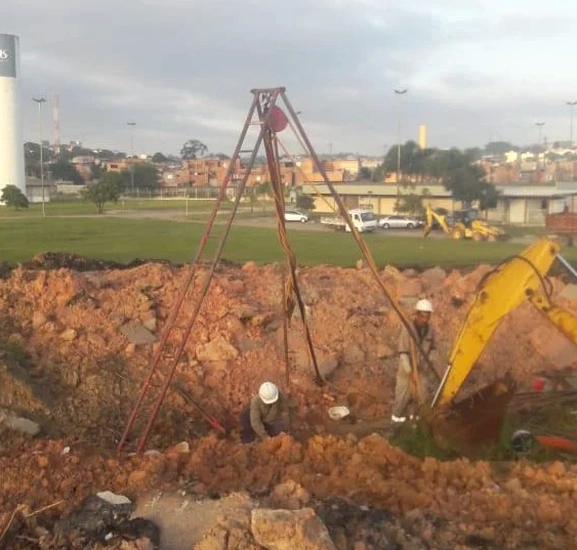
Cheyenne sits at 6,062 feet above sea level, and that altitude brings freeze-thaw cycles that punish reactive soils. The 2015 tornado that ripped through the south side exposed just how variable the near-surface stratigraphy can be here. In our experience, the single most overlooked test in this city is the Atterberg limits determination. It tells you exactly how much moisture a clay can hold before it turns to soup or shrinks into cracked plates. Without that data, you are guessing on foundation depth. The grain-size distribution alone cannot give you the full picture. We run the liquid limit, plastic limit, and plasticity index on every sample pulled from Cheyenne subdivisions east of Warren AFB, where the Pierre Shale and its weathered derivatives dominate the subsurface.
In Cheyenne, a plasticity index above 25 is not a lab curiosity. It is a warning that your slab will move.
Quick answers
What does the Atterberg limits test measure?
It measures the water content at which fine-grained soil transitions from a solid to a semi-solid state (plastic limit) and from a plastic to a liquid state (liquid limit). The numerical difference between those two boundaries is the plasticity index, which indicates how much water the soil can absorb while remaining plastic.
Why is the plasticity index important for Cheyenne building sites?
The Pierre Shale and its weathered residuals across Cheyenne can produce plasticity indices exceeding 30. A PI that high correlates strongly with shrink-swell behavior during our freeze-thaw season. Knowing the PI helps engineers decide between a shallow footing, a deepened perimeter beam, or a structurally suspended floor.
How much soil sample is needed for the test?
We need approximately 100 grams of material that passes the No. 40 sieve. That usually comes from a split-spoon sample or a bulk bag collected during a test pit excavation. The sample should be protected from drying out before it reaches the laboratory.
What is the typical cost for Atterberg limits testing in Cheyenne?
A single-point Atterberg limits determination typically costs between US$60 and US$90 when run as part of a larger geotechnical package. Standalone pricing may be slightly higher depending on the number of samples and turnaround time required.