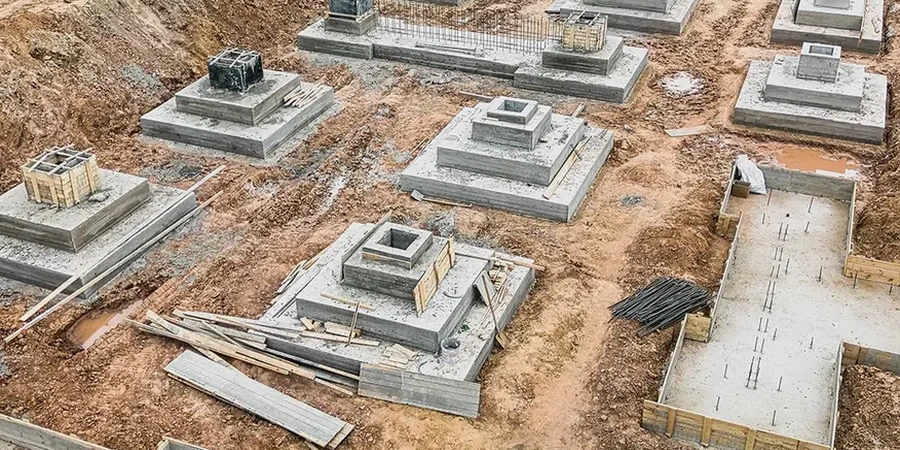
Cheyenne’s early development as a Union Pacific railroad hub in the 1860s concentrated construction along the Crow Creek floodplain, where builders soon discovered that the alluvial silts and clays lacked the bearing strength needed for heavy masonry structures. As the city expanded eastward onto the High Plains and westward toward the Laramie Range foothills, soil profiles shifted dramatically within short distances—from shallow bedrock to 15-meter-deep deposits of wind-blown loess and expansive Pierre Shale residuum. Modern pile foundation design here must account for three distinct subsurface regimes: the competent Sherman Granite near the surface in western neighborhoods, the potentially collapsible loessial soils across the central plateau, and the highly plastic clays in the creek valleys. A thorough site investigation with SPT drilling provides the stratigraphic control needed to select the appropriate pile type and depth for each specific Cheyenne location.
Designing piles in Cheyenne means solving for three loads simultaneously: axial dead load, wind-induced overturning at 52 m/s basic wind speed, and uplift from swelling Pierre Shale.
Our approach and scope
Subsurface conditions across Cheyenne reflect the city’s position at 1,848 meters elevation on a dissected pediment surface between the Front Range uplift and the Denver Basin. The Cretaceous Pierre Shale—a dark gray, marine claystone with swelling montmorillonite content routinely exceeding 40 percent—underlies much of the metropolitan area at depths ranging from 3 to 12 meters below grade. Above this bedrock, Quaternary loess deposits averaging 4 to 8 meters in thickness exhibit metastable structure that can collapse upon wetting, generating differential settlements that exceed serviceability limits for shallow footings. Pile foundation design in Cheyenne typically extends bearing elements through these problematic surficial soils to socket into the shale or granite, with side resistance calculated using alpha methods per FHWA guidelines. Wind loads per ASCE 7-22 control pile lateral design here—Cheyenne’s basic wind speed of 52 m/s (115 mph, Risk Category II) ranks among the highest in the continental United States, and the resulting overturning moments at pile heads demand careful reinforcement detailing and adequate embedment into competent material. Frost depth reaches 1.2 meters, requiring pile caps to be set below this level or protected with rigid insulation per IBC Section 1809.5.
Local ground factors
One condition that repeats across Cheyenne foundation investigations is the presence of a desiccated crust in the upper 1.5 to 2.5 meters of the Pierre Shale profile—a stiff, fractured zone that drillers sometimes mistake as competent bearing material. This crust masks the softer, higher-moisture-content shale beneath, and a pile terminated within the desiccated layer will experience progressive settlement as moisture equilibrium re-establishes after construction. The technical team routinely specifies minimum socket lengths of 3 meters into unweathered shale, confirmed by recovery ratio and unconfined compressive strength testing on continuous rock core. Another risk arises from perched groundwater encountered in the loess above the shale contact; if not identified during the geotechnical investigation and properly considered in the construction-phase drilling plan, this perched water destabilizes auger-cast pile boreholes and reduces side friction during concrete placement. Cheyenne’s freeze-thaw cycles—averaging 140 days per year with sub-zero temperatures—create additional demands on pile cap durability, requiring air-entrained concrete with a maximum water-cement ratio of 0.45 per ACI 318 exposure class F2.
Quick answers
What is the typical cost for a pile foundation design in Cheyenne?
Pile foundation design fees in Cheyenne generally range from US$1,640 to US$5,510, reflecting the scope of subsurface investigation, number of pile load tests required, and complexity of the structural loading. A straightforward single-family residence on loess with ACIP piles falls toward the lower end, while a commercial building requiring instrumented static load testing and lateral analysis for wind demands occupies the upper portion of that range.
How does Cheyenne's wind affect pile foundation design differently than seismic loading?
Cheyenne sits in a moderate seismic zone (Seismic Design Category B per IBC 2021), so wind governs lateral design for most structures up to mid-rise height. The ASCE 7-22 basic wind speed of 52 m/s generates overturning moments at the pile cap that require deeper embedment and higher reinforcement ratios than seismic demands alone would dictate. Lateral load analysis using p-y curves in LPILE typically controls pile diameter and structural section selection here.
Do Cheyenne soils require special pile design for expansive clay conditions?
Yes. The Pierre Shale underlying much of Cheyenne contains montmorillonite exceeding 40 percent, with plasticity indices from 35 to 55 percent. Pile design in these conditions must include an isolation zone through the active moisture-fluctuation depth—typically the upper 3 to 4.5 meters—using sleeving or oversized casing to break the bond between the expansive soil and the pile shaft. The design also accounts for uplift skin friction in the expansive zone, estimated using published correlations between PI and swell pressure from the Colorado Association of Geotechnical Engineers.