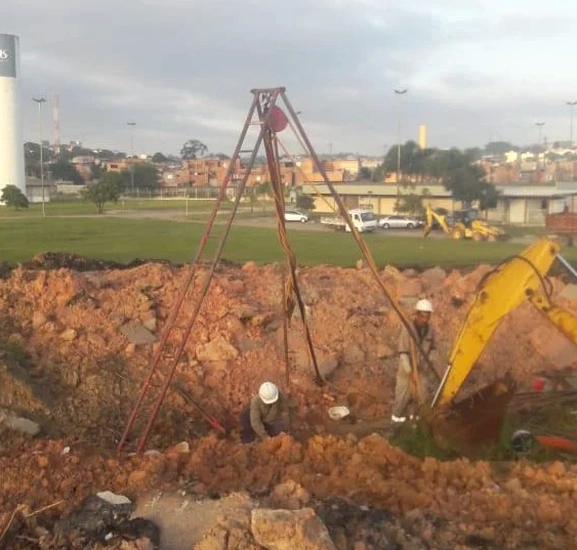
Geotechnical laboratory testing forms the backbone of responsible site development and infrastructure design throughout Cheyenne and southeastern Wyoming. The grain size analysis (sieve + hydrometer) and Atterberg limits suite represent core classification services, but the broader laboratory category encompasses strength testing, consolidation analysis, compaction evaluation, and chemical assessment of soils and rock. For engineers and contractors working in the Cheyenne area, these laboratory determinations translate directly into foundation bearing capacities, pavement design parameters, and slope stability calculations that keep structures safe and durable under local conditions.
Cheyenne's geologic setting presents distinct challenges that elevate the importance of precise laboratory data. The city sits on the High Plains near the western edge of the Denver Basin, where surficial geology includes expansive Cretaceous shales of the Pierre Formation, wind-deposited loess, and alluvial sediments along Crow Creek and Dry Creek drainages. Many of these native soils exhibit high plasticity and significant swell potential, characteristics that can only be reliably quantified through controlled laboratory testing. Seasonal moisture fluctuations in the region's semi-arid climate, with its freeze-thaw cycles and occasional heavy precipitation events, further underscore the need for accurate index property determinations and strength testing programs.
Laboratory testing protocols in Wyoming must comply with established standards that govern both procedure and reporting. The Wyoming Department of Transportation (WYDOT) specifies testing methodologies aligned with AASHTO standards for transportation projects, while ASTM International standards govern most commercial and residential geotechnical work. Key references include ASTM D422 for particle-size analysis, ASTM D4318 for liquid limit, plastic limit, and plasticity index determinations, and ASTM D2487 for the Unified Soil Classification System. Local jurisdictions including the City of Cheyenne typically require certified laboratory results as part of building permit submissions for commercial structures, subdivisions, and public works projects, with testing performed by laboratories accredited through programs such as AASHTO re:source or the U.S. Army Corps of Engineers validation program.
The types of projects driving laboratory testing demand in Cheyenne span a broad spectrum. Commercial developments along the Dell Range Boulevard corridor and new residential subdivisions in the expanding northern and eastern sectors of the city require comprehensive geotechnical investigations with full laboratory support. Transportation infrastructure, including Wyoming Highway 210 and Interstate 25 improvement projects, demands rigorous compaction control testing and aggregate characterization. Municipal projects such as the Cheyenne Board of Public Utilities water and sewer line extensions similarly rely on laboratory-derived soil parameters for trench stability and pipe bedding design. Even smaller-scale projects including retaining walls, stormwater detention basins, and foundation underpinning benefit substantially from targeted laboratory programs that characterize site-specific soil behavior rather than relying on conservative published correlations.
A standard program typically begins with index property tests including moisture content, grain size distribution via sieve and hydrometer, and Atterberg limits to classify soils per ASTM D2487. Depending on project requirements, it may expand to include Proctor compaction testing, direct shear or triaxial strength tests, consolidation analysis for settlement prediction, and swell-consolidation testing for expansive soils common in Cheyenne's Pierre Shale formations. The specific suite is determined by the geotechnical engineer based on subsurface conditions and structural loading.
Field tests like Standard Penetration Tests and cone penetrometers provide valuable in-situ data, but they cannot directly measure fundamental soil properties such as plasticity, grain size distribution, shear strength parameters, or consolidation characteristics. Laboratory testing under controlled conditions allows for precise determination of these engineering properties across varying moisture contents and stress states. The combination of field and laboratory data yields the most reliable geotechnical characterization for design purposes.
Cheyenne's prevalent expansive shales and loessial soils demand particular attention to swell potential and moisture sensitivity. Laboratory testing must include Atterberg limits and often swell-consolidation testing to quantify heave potential under field moisture conditions. Additionally, the semi-arid climate with freeze-thaw cycling requires careful evaluation of soil strength under saturated conditions, as laboratory tests can simulate worst-case scenarios that may not be evident during dry-weather field investigations.
Laboratories performing testing for WYDOT projects must hold current AASHTO re:source accreditation covering the specific test methods required. For federal projects, U.S. Army Corps of Engineers validation may be necessary. Commercial and municipal projects in Cheyenne typically require laboratories to demonstrate proficiency through recognized programs and maintain calibration records traceable to NIST standards. The geotechnical engineer of record is responsible for verifying that the selected laboratory meets project-specific qualification requirements.