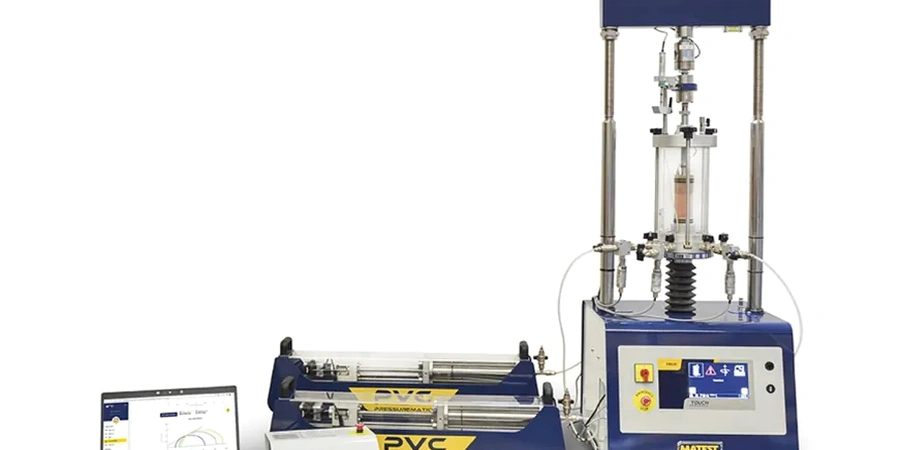
The soil profile beneath Cheyenne changes dramatically within a few miles. Over in the historic Avenues district, you might hit stiff, overconsolidated claystone just a foot below the surface, while new subdivisions sprouting east toward Carpenter often sit on thick alluvial sands with silt lenses that react very differently under load. These two scenarios demand fundamentally different parameters when you are designing a foundation, which is exactly why a proper triaxial test program becomes essential before committing to a structural design. We run consolidated-undrained and drained tests to pin down the friction angle and cohesion intercept under site-specific conditions, often coordinating the sampling with an SPT drilling campaign that captures the stratigraphic variability across a single parcel. Getting the effective stress path wrong here can mean the difference between a routine mat foundation and an expensive over-excavation.
A single triaxial test on a thin silt seam within the alluvial profile can reveal a failure envelope entirely different from the surrounding sand, and that seam often controls the global stability of the excavation.
Local ground factors
The triaxial cell itself is a heavy, precision-machined stainless steel chamber that sits on a stiff loading frame in our laboratory, capable of applying axial loads up to 10,000 pounds while maintaining a constant confining pressure through a digital volume-pressure controller. When we mount a specimen from a Cheyenne site, the first thing we check is the back-pressure saturation response because the native claystone often contains micro-fractures that bleed pressure if not properly sealed with a membrane and filter-paper side drains. A poorly saturated specimen will give you a friction angle that looks five or even eight degrees higher than reality, leading to an unconservative foundation design. The risk compounds when the sample comes from a depth where the in-situ water table fluctuates seasonally, a condition we document carefully during the logging phase so the test program replicates the worst-case pore pressure scenario rather than the driest.
Quick answers
What is the typical cost range for a triaxial test program on a Cheyenne site?
A standard program with three consolidated-undrained tests on a single formation generally runs from US$1.750 to US$2.490, depending on sample preparation complexity and whether drained multistage stages are added to the scope.
When does a triaxial test become mandatory under the IBC for a project in Cheyenne?
IBC Chapter 18 requires shear strength parameters for any foundation design on soil when the bearing pressure exceeds 3,000 psf or when the structure falls into Seismic Design Category C or higher. Given Cheyenne's proximity to the Denver Basin seismic source zone, most commercial and multi-family projects trigger the requirement, and a direct shear test alone rarely provides the effective stress parameters needed for a defensible design.
How do you handle sampling in Cheyenne's expansive claystone for triaxial testing?
The claystone weathers quickly when exposed, so we use thin-walled Shelby tubes pushed with a steady, continuous stroke immediately after the auger clears the sampling depth. The tubes are sealed with microcrystalline wax at both ends in the field and transported in insulated containers to minimize moisture loss, which is critical because even a two percent change in water content can alter the measured shear strength significantly.
Can triaxial test results be used to assess liquefaction potential in the alluvial sands east of Cheyenne?
Cyclic triaxial testing can directly measure liquefaction resistance, though for most projects in the Cheyenne area we combine standard penetration test data with the simplified procedure from Youd and Idriss (2001) and use the monotonic triaxial results to calibrate the constitutive model parameters for a more refined deformation analysis if the factor of safety runs marginal.