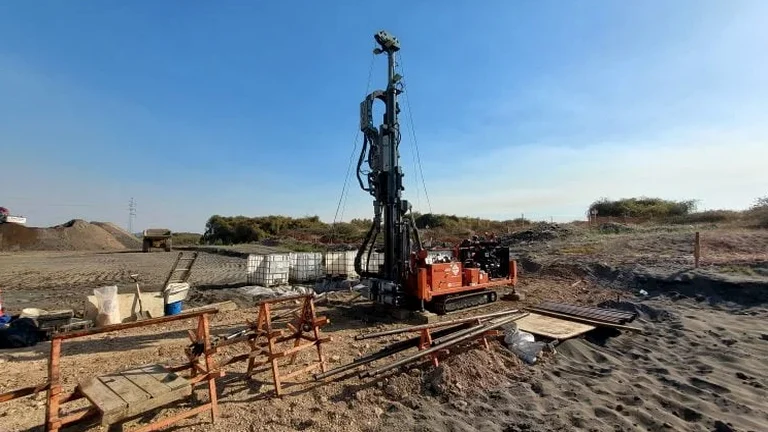
Cheyenne sits at 6,062 feet above sea level — one of the highest capital cities in the country. That elevation, combined with freeze-thaw cycles hitting 120+ days a year, puts real stress on foundations. An exploratory test pit is the fastest way to see what you're dealing with underground before concrete shows up. We open trenches right at the future footing location, log the soil profile per ASTM D2488, and take the samples that drive foundation design. No guesswork, no relying on a neighbor's boring log from three blocks away. For deeper refusal verification in the Sherman Granite formation, we often pair test pits with SPT drilling where the bucket hits refusal above bedrock.
You can read a dozen boring logs and still miss what a 12-foot trench shows in five minutes of looking at the wall.
Our approach and scope
Cheyenne's subsurface is a mix of weathered Sherman Granite, colluvial silty sands, and wind-deposited loess on the east side near the Crow Creek drainage. An exploratory test pit lets us examine the contact between natural ground and any undocumented fill — common in older neighborhoods south of Lincolnway where ranch-era structures were leveled. Our excavator typically reaches 10 to 14 feet in open ground, enough to inspect bearing strata for shallow foundations. We collect bulk samples for lab work:
grain size analysis to classify the material per USCS, and moisture content profiles that feed into
Proctor compaction testing when fill placement is part of the site prep. For jobs within the IBC Site Class D envelope, we also pull undisturbed Shelby tubes from pit walls for strength testing.
We run a tight operation on site. The pit gets logged with Munsell color, consistency, moisture condition, and any seepage noted — groundwater shows up seasonal in lower areas near Dry Creek. Photos are taken every two feet of depth with scale reference. If we hit refusal on weathered granite float, the pit still delivers value: you get confirmation of rock depth without a drill rig mobilization, and the exposed surface lets us assess fracture spacing and weathering grade directly. Backfill is compacted in lifts if the pit footprint falls within the building envelope.
Local ground factors
Cheyenne grew along the Union Pacific rail corridor, and plenty of lots near the historic depot and west toward the refinery were built on reworked ground — old stockyards, coal-ash fill, buried rail spurs. Skipping an exploratory test pit in these areas means rolling the dice on differential settlement. We've opened pits where the first four feet looked fine only to find cinder fill and rotted ties at six feet. That changes your bearing capacity assumptions overnight. East Cheyenne neighborhoods developed in the 1950s–70s on loess-mantled terraces; loess collapses when it gets wet and it doesn't warn you first. A test pit lets you see structure in place, something no CPT cone can replicate. If the pit walls stand vertical for hours, that tells you something about cohesion. If they ravel immediately, that tells you something else. Both observations feed directly into excavation support design and slope stability analysis if the site has grade changes.
Quick answers
How much does an exploratory test pit cost in Cheyenne?
A single exploratory test pit in Cheyenne typically runs between US$540 and US$790, depending on depth, access, and whether lab testing is bundled. Multi-pit packages for full site coverage bring the per-pit cost down. We provide a fixed-price proposal before mobilization so there are no surprises.
How deep do you dig an exploratory test pit for a residential foundation?
For residential work in Cheyenne, we normally go 8 to 12 feet deep — enough to get below the frost line and into competent bearing material. If we hit weathered granite float shallower than that, we stop at refusal and document the contact. The pit depth always extends at least 3 feet below the proposed footing elevation per IBC requirements.
Do you need a permit or locates before digging a test pit?
Yes. We handle Wyoming 811 utility locates as part of mobilization — it is mandatory before any excavation. For pits deeper than 5 feet within the building footprint, OSHA Subpart P applies and we follow Type C sloping or benching protocols. City of Cheyenne right-of-way work requires an encroachment permit; on private lots, no city permit is needed for geotechnical investigation.